Staying

Dear babies,

We've always been good on-the-go, haven't we? Grocery trips and Sonic runs—these have been our saving grace many times.

Outside our house, the world seems to have order. Peanut butter jars lined up on grocery store shelves, neatly cut grass, stamps sold in perfect little booklets. I've always loved the precise beauty of a sheet of stamps.

But inside our house, nothing is lined up. You and I both make sure of that. (Dad helps some, too.)

Because once we get home from the grocery store, and I try to put the food away while you grab at my legs, I often find myself longing to get out again, back to the orderly place. Because usually I’ve forgotten a crucial ingredient, or I bought too much or too little, or it isn't very healthy, or it was too expensive, or maybe it was all the right things but then I burned it anyway or you threw it all on the ground. At our house, often everyone is loud, and the piles of laundry and toys and dishes seem like they're expanding, inching closer to us, conquering another square foot every few minutes. I fear the chaos will eventually swallow us up, and we'll tumble into a black hole of madness, never finding sure footing again.

So sometimes it feels easier to get out. To leave the bloated mess to devour us another day, to go somewhere where we can pretend to be calm, a place where I can carry a list and feel accomplished, where you can be distracted by crackers or at least fall asleep in the car.

Going is good—but sometimes I make us go because I’m not brave or strong enough to stay. Staying requires a different set of muscles entirely. Staying is hard, especially for people like us who naturally perk up around new scenery.

But here’s a truth that I’m learning about these too-familiar walls, babies. God is here. Right here, in our house. It’s not too messy for him, and it’s not too loud for him. He knows that it’s our mess, and it’s our loud, and he likes us. He likes to stay with us. He’s good at it. 

God goes with us, too, but I’m realizing that there’s something particularly beautiful about seeing him in the staying, in the overly familiar, in the mundane.

My brain rails against this idea, and I often find myself dreaming of the going—doing important work, teaching with conviction things that matter, and I start to piece together the words, but you're upset again, and the words slip away. Good words have never been much match for your best word: "mama." And there’s something in the tone of your voice that God put there to remind me that I’m already doing important work. Beautiful, staying work, work that requires different muscles. Hanging with you, helping you learn things, comforting and feeding and loving you—these are millions of tiny steps that eventually complete a marathon. My greatest victory. My best work.

Babies, remember what your mama is learning about God—that he doesn’t just live at the finish line. He fills up every square inch of the path and the lungs inside your chest. He doesn’t just live in the crises and big joys. He fills up the Thursdays and the nap times and the no-one-napped times. He doesn’t just live in the orderly place of Bible study and highlighters and coffee. He fills up the laundry room and the coat closet and your mama’s heart. I know that because sometimes he holds my hands when I pause over the sink of dishes, because I’m overwhelmed, and he’s trying to make me rest.

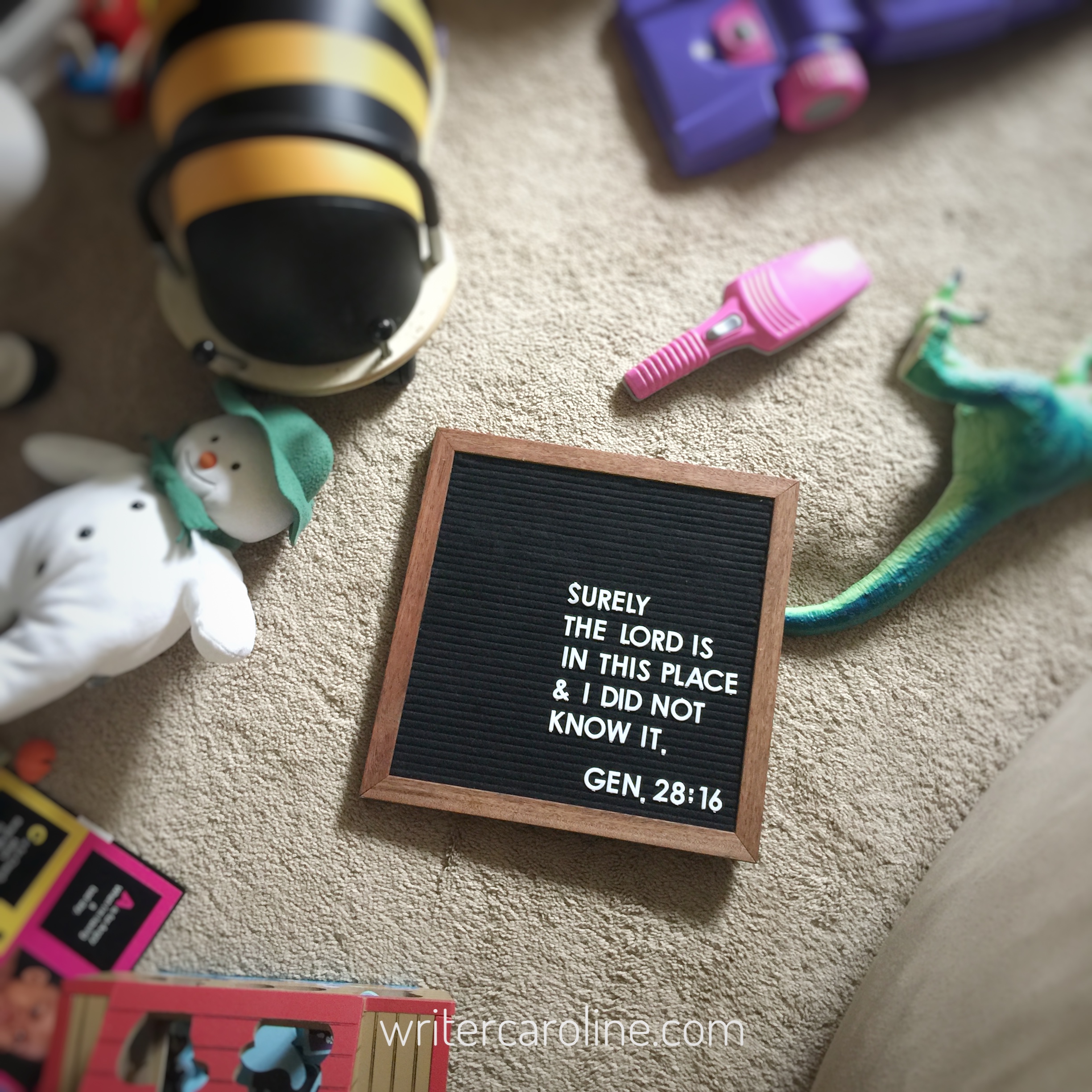
It’s at the sink that the words of Genesis 28:16 leap into my mind: “Surely the Lord is in this place, and I did not know it."

Oh, babies, this kitchen floor is holy ground, too. Sometimes it’s mopped and sometimes it’s covered in rejected grapes and spilled flour, but it is holy nonetheless.

Alongside the blocks and sticky counters, God has things to teach us. So let’s stay in this messy house together a little more. Maybe it’ll get clean today, or maybe it won’t. But God is not some grumpy houseguest. He’s here for the long haul—steady, constant, unchanging, and never ever intimidated by our mess.

Babies, don’t let me lament the dirty house or fret too much over its noise. That makes it seem like I don’t love this place, but I certainly do. I love this messy house because God is here, and because you’re here, and I really like you. I want our house to be the place where you learn what God’s like, so I’m praying that God will teach me to be like him: steady, fearless in the face of mess, constant in the tumult. 

In this messy place, you are safe to be a mess. Here’s you’ll find a soft place to land when the world prickles. Here you'll always find a heart that loves you, arms ready to pull you in. In this loud place, you can yell or cry or laugh, and you will be heard. Here you’ll always find someone to brush your hair back and sing our song: “So goodnight, my someone, goodnight.”

Babies, what a good God we serve that he would choose to answer prayers in our kitchen. To provide wisdom at our coffee table. To grant comfort as we rock together in that glider.

He fills this house, and he makes it a place worth staying.


“Am I a God at hand, declares the Lord, and not a God far away? Can a man hide himself in secret places so that I cannot see him? declares the Lord. Do I not fill heaven and earth? declares the Lord.” Jeremiah 23:23-24
Let Them Be Weird

One of my favorite pre-children pastimes was attending midnight premiere movie showings and feigning obsessive interest. I AM VERY GOOD AT BEING EXCITED, even if I’m not sure why I’m excited. Mainly, I love move premieres because I get jazzed seeing people fully embrace things they love. Screaming at the sight of the full moon at the beginning of Twilight: New Moon, stretching out my hand to 3-D Justin Bieber, spending hours perfecting my Katniss braid—all things done in the name of hysteria participation. In a shrieking crowd united over one weird thing or another, I am a happy camper. In fact, this sums up a lot about me: Around shrieking, I am a happy camper, and around camping, I am unhappily shrieking. 

So yeah, I’m an advocate of the indoors, of being excitable, and of weirdness. The first is a character flaw, and I’m working on it (no I’m not), but the latter two are pretty life-giving. Especially weirdness—the best things are always a little weird, and really, when people appear too “normal,” it’s probably a sign that they have a giant jar of toenail clippings in their closet.

But though I am only mildly troubled by toenail clipping collections (I mean, we’d all probably watch that TLC show, right?), I am tremendously troubled by this uglier-than-toenail-clippings thing I’ve been noticing. It’s been happening as long as I can remember, and I’ve been involved more often than I’d like to admit. The ugly thing bothers me because now I’m a parenting some people, and I want to raise my people to be the little weirdos God created them to be. But they’re growing up in a world, as did I, that loves to do this ugly thing: stomp on weirdos.

Sometimes I forget about my love for weirdos and premiere-goers. Sometimes I'm the stomper.  About a month ago, my husband and I were in Madewell. It’s a super cool store full of chill, fashionable clothes and the people that belong in them, and I was basically just trying to keep my voice down, so as not to taint the coolness and beauty of the place. Luke was not—in fact, he was playing PokemonGo. POKEMON IN MADEWELL! This is such a violation of the Madewell cool girl vibe, and I just cannot emphasize this enough. “You cannot catch Pokemon in Madewell, Luke! This is MADEWELL,” I hissed, like a thirteen year old who can’t believe her dad is wearing cargo shorts. (“Don’t write that,” says Luke. “People will think I wear cargo shorts.”) 

Luke’s response to my thirteen-year-old girl hissing: “I got one!” (A Pokemon. Ugh.)

One thing to know about Luke is that he has a big voice. Another thing to know about Luke is that he doesn’t know that he has a big voice. Luke was basically yelling about Pokemon in Madewell, and though this was a welcome break from his "I hope this is made well," joke, the midi skirts were still coiling in disgust.

First I contemplated hiding behind the cognac leather bucket bags, and then I decided too be mature and accept my reality, like, “Ugh, in sickness and in health, y’all. Guess I’m stuck with this loser forever.” But later I read something Sarah Bessey wrote about Pokemon and Pokemon haters, and it reminded me: Weirdo-stomping is not a good fit for the person I want to be. She said, “Feeling superior to other people is tempting, I know; it's even more tempting than being angry. It's fun to think we're better because of the games we play, the books we read, the songs we sing, the music we listen to, the doctrines we believe, whatever. I've learned by now to be a little wary of my own sense of superiority. I see it in myself and it's always gross. Snobbery is never a good address. Because we all have weird stuff we enjoy and we should let people love what they love.”

Yep. I got called out. I loved it. Because getting on to your husband for doing something weird seems like a silly issue on the surface, but it’s not really that silly. It means on some level I cared more about the way we looked to strangers than him doing his fun thing. I let the presence of a few flannel shirts and jumpsuits and ankle boots turn me into a big fat fun squasher, and I DO NOT WANT TO BE A FUN SQUASHER. I’ve got to let Luke be Luke, to love what he loves, do his little weird things, even if it’s wearing camo crocs here and there (NO NO NO I TAKE IT BACK I CANNOT DO THIS PRAY FOR ME). But camo crocs notwithstanding, we’ve got to let people love what they love. We’ve got to be brave enough to be weird ourselves, but we’ve got to be kind and patient enough to let other people do the same thing, even when we don't understand their brand of weird.

Do I understand Star Wars? Not really. Space stuff of any kind is not really my cup of tea (although I have taken several of my best naps in planetariums), unless we are talking space ice cream (Dippin’ Dots), in which case I will take several cups, thank you. But I officially support your Star Wars t-shirt/DVD/figurine/whatever collection (can you tell I have no idea what I’m talking about?), and you should definitely rock Leia or Rey or wookiee hair, even if t's not Halloween, even if you go into Madewell, and really we should all work the word “wookiee” into our vocabulary a bit more because it makes our ears happy. Does my husband understand my need to give everything we own a name? Ms. Nancy Bobo the blender and Peter the pan and Ida the iPhone and what not? No, this gets on his nerves. Especially when it's hard for me to get rid of my old iPod Nano because her name is Nanette, and what if Nanette develops abandonment issues? And yeah, maybe I have spent a significant portion of both my childhood and adult life trying to figure out how to make my room look like the inside of the bottle on I Dream of Jeannie. IS THAT A CRIME? No it is not, and if anyone feels called to find me some round purple pillows and renovate my house so that the rooms are circular, that would be great.

So, look, you little weirdos, live long and prosper and catch those Pokemon and maybe even some toenail clippings. Be weird in Madewell, be weird at your house, be weird wherever you go, and do not fear stomping from me. I've given it up.

In conclusion, please picture me rolling down my van window in future car line and yelling, "Be yourself!" and then picture how much this will mortify my children. The end.

A Wretch Like Me

Would you like to hear a bad metaphor?

My heart is a sun. It’s hard to look at. When I’ve been brave enough to stare at my heart directly, to consider its shape and composition, its deep places and shallow, I have to look away. It’s a sun.

I don’t look away because of the brilliance or brightness. It’s not a blazing light that causes my eyes to sting. I look away because of darkness—darkness too overwhelming to bear, darkness that begs me to divert my gaze. Within it I see my true intentions, my deep insecurities, my fears, my propensity to pick the wrong thing, the ugly thing, the cruel thing, and they swirl about viciously in an ominous, oppressive cloud, and I realize: there is nothing good here at all. There is no light here to guide me.

This is where the metaphor goes bad. My heart is not a sun at all. There's no light in it.

The world tells me “Follow your heart.” The world promises that if I am true to my heart, I will find what I’m searching for. 

I’ve often listened closely to my heart, indulged in its whispers. Yet when I am honest about its voice, I realize it sounds hollow and cold. It sounds like darkness. 

Shall I follow the darkness? Shall I wrap myself in its shadows? It’s a tempting thought—there is rest to be found amongst shadows. But only for a time. For what true rest will I find in the dark heart-whispers about my marriage (It’d be easier to do this without him; he doesn’t really love you), about my parenting (Everyone is watching; you need to hustle more; be perfect and you can stay ahead of judgements), about my passions (You don’t have anything original to say; everyone is tired of listening to your words anyway), about my body (Everything will be better if you’re thin—look how stupid you look when your clothes don’t fit right)?

Sometimes my heart tells me unspeakable things, things of true ugliness. Things that if you saw them, I’d be outed. You’d be on to me. You’d know that I’m a phony.

For what can be said about a girl who does good things, but when she is honest and brave enough to really look, she finds that they are guided by ugliness? What can be said for a girl who talks about God but secretly hopes people give her the praise? What can be said for a girl who silently measures herself up against everyone in the room? What is her heart made of?

“The heart is deceitful above all things, and desperately sick; who can understand it?” Jeremiah 17:9

Part of maturity is learning whom you can trust and whom you cannot, and my journey has led me inward. For I now know that in the truest parts of me, I desperately want to follow Jesus, but at the same time, I watch, horrified, at the ugliness that still thrives. Paul’s words ring true in my life: “For I do not understand my own actions. For I do not do what I want, but I do the very thing I hate” (Romans 7:15).

I hate harsh words, snap judgments, condescention, self-centeredness, pride, and yet when I dig around in my heart and pay attention to my thoughts and actions, I see these very things. Even as I plan a Bible study or a talk, I catch myself prioritizing not what people think about God but what they think about me—will they think I’m funny? Will they think I’m wise? Sometimes I wonder—do I even trust the Bible to transform, or has pride somehow convinced me that transformation is my job? Do I believe Jesus is the Savior, or do I think it’s me?

And so I find this to be hauntingly true: Even the good things I do are gross. God knew what he was talking about in Isaiah 64:6: “All our righteous deeds are like a polluted garment.” These are the words that echo in my brain when I work to redeem clothes that have endured accidents from a potty-training toddler. I hold the filth in my hands and think, “The good things I do are like this.” It’s the wisest thing I’ve ever learned from laundry.

For I know that nothing good dwells in me, that is, in my flesh. For I have the desire to do what is right, but not the ability to carry it out. For I do not do the good I want, but the evil I do not want is what I keep on doing. Now if I do what I do not want, it is no longer I who do it, but sin that dwells within me. So I find it to be a law that when I want to do right, evil lies close at hand. For I delight in the law of God, in my inner being, but I see in my members another law waging war against the law of my mind and making me captive to the law of sin that dwells in my members. Wretched man that I am! Who will deliver me from this body of death? Thanks be to God through Jesus Christ our Lord! So then, I myself serve the law of God with my mind, but with my flesh I serve the law of sin.” Romans 7:18-25

Wretched woman that I am! Who will deliver me from this body of death? Thanks be to God through Jesus Christ our Lord!

Jesus is my rescue. He is my rescue when I stare at my heart with burning eyes, quickly looking away because I cannot bear it. He is my rescue when I am overwhelmed to find that there is no light there to guide me, only oppressive darkness.

Perhaps that’s why Jesus was called the Light of the World. “In him was life, and the life was the light of men. The light shines in the darkness, and the darkness has not overcome it” John 1:5.

I can look at my heart and say this: “The light shines here, in this darkness. This darkness will not win.” He saw it all—the things I try to hide from you, all the ways I’m a phony, the motivations behind my seemingly good acts, all the fears I scribble on top of articles I write (“You have nothing original to say, no one wants to hear you talk”)—he saw all of that and chose to rescue and love me anyway. The light shines in the darkness, and the darkness has not overcome it! Thanks be to God!

And so those good things—the disgusting, stained clothing things—I will be faithful to do them anyway, to recognize and call out the ugliness when I see it, to fearlessly pursue good, to continue to string good words together even though darkness discourages me and failure scares me. Because God in his overwhelming goodness is not only my rescuer and the lover of my unlovable heart, he lets me borrow his metaphor: “You are the light of the world,” Jesus said in the Sermon on the Mount. What kind of God loans his followers, possessors and purveyors of darkness, his very own metaphor? What a mysterious honor!

He continues: “Let your light shine before others, so that they may see your good works and give glory to your Father who is in heaven” (Matthew 5:14). We ought to shine, because our darkness has not overcome his light, and even though our light shines bleakly in comparison to his, it is powerful enough to bring him glory.

And so we shall stay faithful. We shall recognize the darkness in our own hearts by being brave enough to look at them honestly. And when the overwhelming darkness makes our eyes burn, we can divert our gaze to the one who inexplicably loves us, who inexplicably rescues us, who inexplicably lets us be light like him.

“Whoever does what is true comes to the light, so that it may be clearly seen that his works have been carried out in God.” John 3:21

For the Women Who Know How to Hate Themselves

Is there anything more insidious than insecurity? It cripples us, it changes us. It makes us hate each other, it makes us hate ourselves. It’s what drives the girl to do the thing she said she’d never do with the guy she only kind of likes. It’s what drives the girl to take the drink she said she’d never take to impress people she doesn’t really know. It’s what draws us to judge both of those girls and draws them to judge us right back.

It’s what teaches us to despise parts of ourselves and then fear when those very qualities show up in our daughters, provoking us to talk to them the way we talk to ourselves: “You’ll never fit into your Homecoming dress if you keep eating like that.”

Dear God, teach us to be gentle!

But, even if we train our mouths to be gentle, this is still true: Insults don’t have to be verbal, and they don’t have to be external. Sometimes your own brain or the fitting room mirror or the unreturned phone call shouts, “You’re unworthy,” as loud as a megaphone. 

And so while God’s Word esteems stillness and “gentle and quiet” beauty, dark, internal roars shake us and shake our daughters with soul-deep tremors. Sometimes the tremors are startling enough to awaken us from the striving to sudden clarity. We realize that all of it—clothes, products, gym visits, relationships, perfectionism, talent, work ethic—is not enough to quiet the internal quake. So we try to talk louder than our noisy insides, affirming ourselves and affirming our daughters, hoping Post-It Note words of worthiness are weapon enough. But here’s the thing: “You’re beautiful” doesn’t stick. “You’re worthy” slides off after a minute, like a slab of butter atop a hot pile of pancakes we’re not supposed to eat.

We arm ourselves with affirmations in hopes that they kill the insecurity, that they pierce deep, but insecurity is bullet proof. We can tell our daughters every day that they are beautiful, worthy, and enough, but ultimately these words are not the solution for which our souls long, because even beautiful girls with kind and intentional parents know how to hate themselves.

A verse often prescribed for insecurity is Psalm 139:14: “I praise you for I am fearfully and wonderfully made.” We scribble it on birth announcements and cards of encouragement, and Christian high schoolers are notorious for proclaiming it beneath a carefully edited selfie on Instagram. But, as I learned from Jen Wilkin’s examining of the passage in her book None Like Him, we sometimes favor Twitter-friendly succinctness instead of the full weight of the statement; a statement that begins with three powerhouse words: “I praise you.”

Our “fearfully-and-wonderfully-made”-ness is cause for praise, certainly, but praise for whom exactly? Ourselves? Of course not. We made Bs in high school biology, but God invented the whole thing. We can barely cook without a recipe, and yet God created us from scratch with zero ingredients. When we look in the mirror, our reflection is cause enough for us to hit our knees in genuine, grateful praise to the Creator. An opportunity to shout, “Look what God has done!” Praise that The Great High King who measures the oceans in the hollow of his hand (Isaiah 40:12) would form us with those same careful hands, attentive to every detail. 

How sinister then that our enemy would wage war on our details, and that we in our own selfishness would stare at God’s creation, fixating on body shape and skin tone and hair texture rather than the God who took dust and made it walk and talk and breathe.

We are wonderfully made—created by the Artist who created all other artists. An Artist who certainly only creates masterpieces, and yet how absurd for the Mona Lisa to pat herself on the back for her masterpiece-ness when it was Leonardo da Vinci that wielded the brush and granted life to a blank canvas.

We are fearfully made—created with such intricacy that upon realizing it, we find ourselves captivated with holy fear, in awe of the Creator. An awe we see just a few verses ahead in the very same chapter: “Such knowledge is too wonderful for me; it is high, I cannot attain it” (Psalm 139:6).

Or consider God’s response as Moses insecurely worried about his ability to speak to Pharaoh on behalf of the enslaved Jews. God didn’t respond with a pep talk, accolades, or affirmations of Moses’ worthiness. He didn’t say, “You can do it!” He said, “I can do it.” As Jen Wilkin so wisely points out in her book Women of the Word, God responded with himself. And that was enough.

“Who has made man’s mouth? Who makes him mute, or deaf, or seeing, or blind? Is it not I, the Lord? Now therefore go, and I will be with your mouth and teach you what you shall speak.” (Exodus 4:11-12)

Dear mothers and daughters, here is the salve for the soul struggling to find worth:

Our God is the Artist of all artists, and our insides and outsides are evidence of His skilled hand. He is beautiful beyond description, and He loves us beyond explanation. These truths are weapon enough. May our mirrors point us to Him.

“I praise YOU, for I am fearfully and wonderfully made. Wonderful are YOUR works; my soul knows it very well” (Psalm 139:14, emphasis added).

Originally posted as "Insecurity: Our Daughters' Greatest Enemy" at MissionalMotherhood.com in May 2016. Reposted with permission.

Connect, Don't Compete

Measuring. I saw it at work when I taught middle school, when my husband was a student pastor, in exercise classes, in my own life: Friends suspiciously eyeing one another’s clothes, suspiciously listening to one another’s stories, suspiciously analyzing one another’s social media accounts. We hang out with one another, but our brains are calculating figures our mouths are not, and while we spew compliments and feign laughter, our brains are busy measuring, measuring, measuring. How good am I compared to her? Do I belong here? Is she better than me?

“Connect, don’t compete.” It’s my friendship mantra. I can’t quite remember where I picked it up, but it’s proven to be a convenient thing to carry in my back pocket. 

I have the greatest friends in the world. Friends who encourage me, friends who leave soup in my mailbox when I’m sick, friends who hold up my arms when life is too much, friends who send me updates on Amelia Earhart’s whereabouts (WHERE IS SHE), friends who surprise me on my birthday wearing cardboard cutouts of my face. On more than one occasion I have been close to tears when reflecting on those God unexpectedly and perfectly plunked into my life when I was battling loneliness, feeling misunderstood, unliked, and overwhelmed. For me, friendship is one arena in which God has proven his faithfulness over and over again.

I’m an extrovert through and through, and I get sad and very very weird when I’m left alone for too long, falling hard into Wikipedia until I’m crying over a random historical figure (looking at you, George Washington Carver), painting something that does not need to be painted, Instagramming seven times in a row, walking around the house sobbing about the mess without actually ever cleaning anything. God made me a certain kind of way, and he knows I’m better when I have people around me. And though that’s true for me practically, it’s true for all of us spiritually: We are better together.

But “better” is the danger word, the one that alarms the Enemy. Because the together things are better things, they are vulnerable to attack. As much as I love my friends and as much as I root for them, my heart is ugly, and often it bristles when someone is wiser, more talented, better dressed, thriftier, thinner, prettier, in a healthier marriage, is a better parent, whatever. My heart gets out its wonky measuring tape and turns my insecurities into a challenge: I must be as good as her. No—I must be better. “Better” gets distorted, changing from a “we” thing to a “me” thing. 

For a girl who used to spend softball games doodling her name in the dirt, competition is an unfamiliar phenomenon. Often I don’t even recognize it for what it is, but it’s certainly there, and in friendship its about as helpful as a dirt-doodler on your softball team. In fact, it’s toxic. Over the past few years, God has been calling me out, showing me when my spirit of competition blocks the holy connection between friends. He's teaching me that measuring tape is a noose that chokes the life out of a friendship, leaving only empty shells exchanging niceties. 

God have mercy on us, friends who have clung to measuring tape rather than each other!

The heart of competition is pride: I’m better. But the heart of connection is this: We are better together.

And yet there’s still something better than “better together.” The heart of the Christian is supposed to be sacrificial in addition to being relational: “You can be better, and we can still be together.” We must not only let our friends shine, but shine bright, and shine ever brighter supported by our encouragement. Because light is good and brings glory to God, and we root for it wherever it can be found, faithfully battling the internal screeching voice that begs us to compete.

And then the heart of the Christian takes it a step further than “better together,” further still than “you can be better” to the ultimate: “God is always, always better. Let’s pursue Him together.”

These are the friendships that change us from the inside out, eventually extending beyond the friendship itself to change our families, our churches, and our communities. These friendships pack a punch, and they are worth the battle.

And so when we want to compete, we choose to connect instead. We give less advice and more love. We make our living rooms safe places for hard conversations, for tears, for unwashed hair. We fill the air between us with life-giving words: “You are working so hard to be patient with your kids. You are teaching me so much.” We “outdo one another in showing honor” (Romans 12:10),  looking for ways to put one another first, looking for ways to Jesus-love one another.

We “take captive every thought to obey Christ,” (2 Corinthians 10:5), training ourselves to recognize our brain's measuring tape as a threat, refusing to create distance with competition. When our “better” gets out of whack, we must jolt it back into place, reminding ourselves over and over: Connect, don’t compete. Connect, don’t compete. Connect, don’t compete. We are better together.